

Windsurf
Configure Windsurf IDE to use Large Language Models hosted by Kimchi via the Roo Code extension.
This tutorial walks you through configuring Windsurf to use an OpenAI-compatible API to access LLMs hosted by Kimchi. Because Windsurf does not natively support custom third-party model providers, you'll install the Roo Code extension to route requests through the Kimchi base URL.
Overview
By the end of this tutorial, you'll be able to:
- Use Kimchi-hosted models inside Windsurf
- Route AI requests from Windsurf to Kimchi through Roo Code
Windsurf's native BYOK only supports Anthropic models. To use an OpenAI-compatible endpoint such as Kimchi, you need Roo Code.
Prerequisites
- A Kimchi API key from app.kimchi.dev/settings
- Windsurf IDE — Download from windsurf.com
- Roo Code extension — Install from the Windsurf Marketplace
Configure Windsurf
Open the Roo Code panel
In Windsurf, click the Roo Code icon in the Activity Bar. If this is your first time, follow the wizard and choose Use without an account.
Configure the third-party provider
In the Roo Code Choose a model provider panel:
- Choose 3rd-party Provider from the provider list.
- Set API Provider to
OpenAI Compatible. - Set Base URL to
https://llm.kimchi.dev/openai/v1. - Set API Key to your Kimchi API key.
- Select
kimi-k3from the model list. - Save the configuration.
Your settings should look like this:
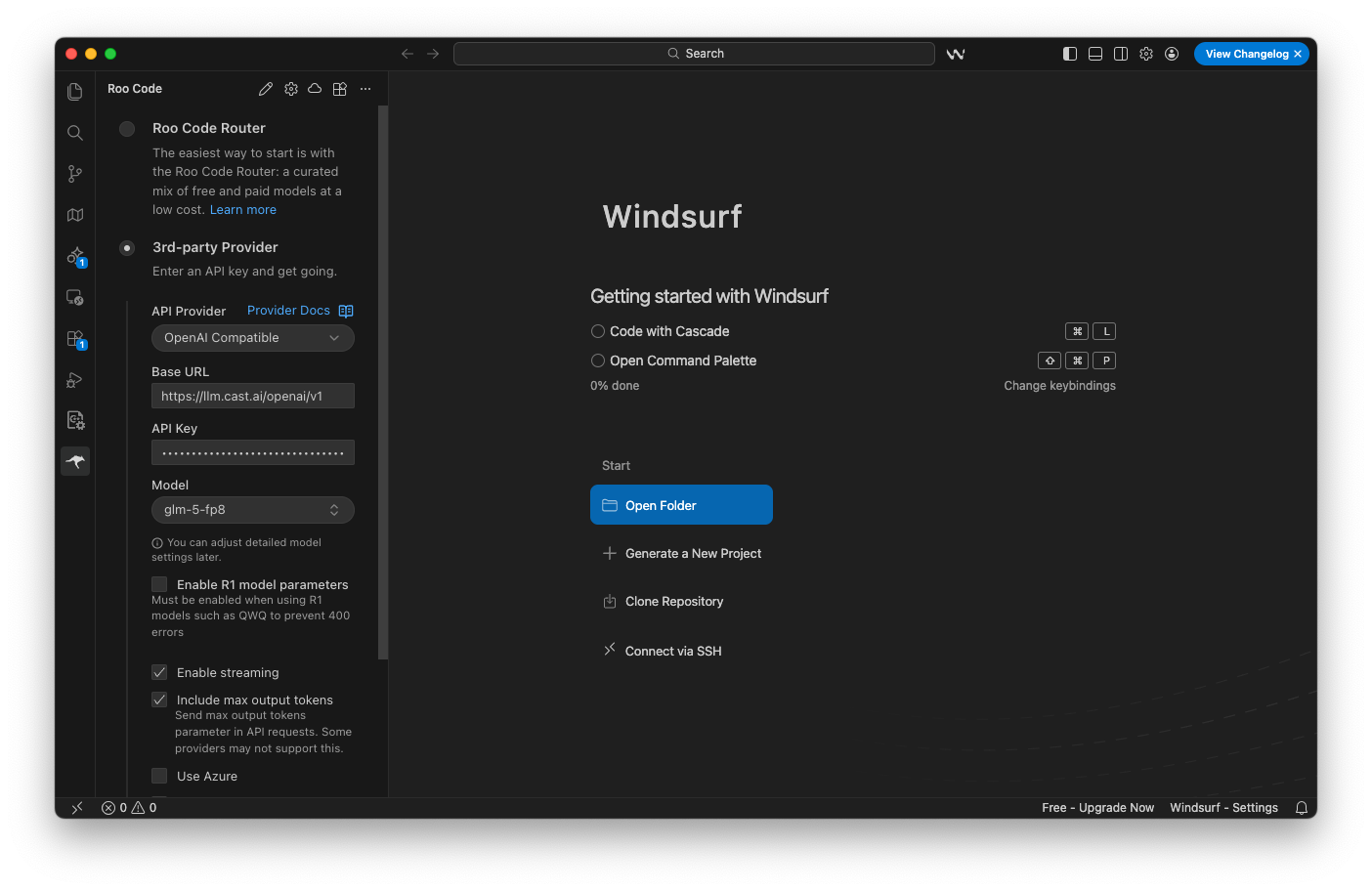
Roo Code LLM Provider Settings — API Provider, Base URL, and API Key configured
Verify your configuration
Open the Roo Code chat panel and send a test prompt — for example, Hello. If you receive a response, the connection to Kimchi is working.
Next steps
Updated about 1 month ago